

Different Types of Traditional Saree Draping Styles in India 2026
The saree is probably the oldest piece of clothing that is still worn every day in India. It is six to nine yards of pure elegance, a style that has lasted through hundreds of years of changing fashion trends. Even in 2026, when digital fashion and minimalism are popular, the saree is still going strong. It changes and adapts, but it stays a staple in Indian clothing.
A saree is never just a piece of cloth. It is a canvas that changes shape depending on the culture of the person wearing it. Every fold in the Nivi style, from the pleats to the pant-like drape of the Nauvari, tells a story about the land, the weather, and the people. If you’ve ever wondered why the drape changes every few hundred kilometers in India, you’re looking for a deeper cultural explanation.
This guide looks at the colorful world of Indian weaves and the stories they tell through their drapes.
The Cultural Significance: Decoding Saree Draping Meaning
Before we get into the different styles, it’s important to know what saree draping means in a cultural sense. Why do women in Maharashtra wear it like pants, but women in Bengal wear it without pleats?
Historically, the way a saree is draped has to do with its use and the job. In coastal areas where women worked in water or fields, the drapes were shorter or pulled between their legs to make it easier to move. In colder places or more traditional societies, the drapes were very full and covered the whole torso.
The saree draping meaning has changed a little since 2026. It still honors tradition, but it has also become a way to show who you are. Modern Indian women are bringing back old drapes not just for weddings, but also to reconnect with their roots. Learning this meaning turns the saree from just a piece of clothing into a strong symbol of culture.
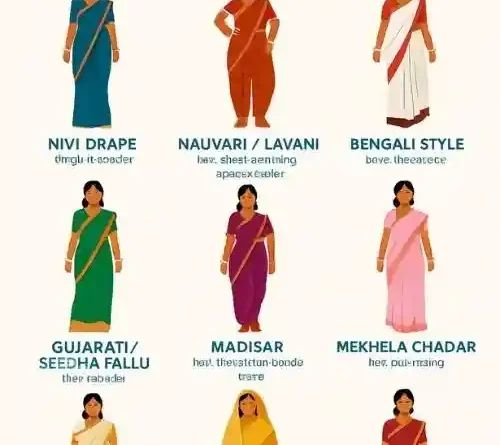
1. Nivi Style (Andhra Pradesh)
When you think of a saree, you probably think of the Nivi drape. This style started in Andhra Pradesh and has now become the “Indian saree” style around the world.
How It Looks
In the Nivi saree wearing style, you tuck the pleats into the waistband in the middle and let the pallu (the loose end) hang over your left shoulder. It looks nice, lets you move around easily, and shows off the saree’s border very well.
Why It Remains Popular in 2026
People like it because it can be used in so many ways. The Nivi drape looks good with almost any fabric, whether it is a heavy Kanjeevaram or a light chiffon. It looks good on almost everyone, so it’s the style to wear to red carpets, the office, and casual outings.
2. Atpoure Shari (Bengal)
The Atpoure is a traditional Bengali saree wearing style that is easy to spot because of its white fabric and red border. Today, it can be worn in many different colors.
The Unique Drape
The Bengali saree has wide box pleats, which is different from the Nivi. The pallu is the most unique part. It goes from the back to the front on both shoulders. In the past, a bunch of keys was tied to the corner of the pallu that was thrown over the right shoulder. This showed that the woman was the head of the household.
Cultural Vibe
This style gives off an air of strength and grace. You will see it a lot during the Durga Puja festival. The lack of tight pleating at the waist makes it comfortable, and the double-shoulder drape gives the torso a royal look.
3. Nauvari (Maharashtra)
The Nauvari saree style, or nine-yard saree, is a work of art in how it is draped. The Kashta saree is another name for it.
The Pant-Style Drape
The most important thing about the Nauvari is that it doesn’t have a petticoat. To drape, pull the center pleats between the legs and tuck them in at the back. This makes the pants look like pants. This gives you a lot of freedom to move around.
Historical Context
History says that Maratha women wore this style to ride horses and fight wars with men. The meaning of saree draping here is literally one of strength and speed. In 2026, this style made a big comeback in fusion fashion. Younger people who like the warrior-queen look often wear it with boots or sneakers.
4. Seedha Pallu (Gujarat, Uttar Pradesh, Odisha)
The Nivi saree style puts the pallu over the left shoulder and then back, while the Seedha Pallu Saree style brings it from back to front over the right shoulder.
Visual Appeal
By putting the pallu across the chest, this style shows off the intricate embroidery on the loose end of the saree. This is how most women in Gujarat dress, and it’s also common in parts of Uttar Pradesh and Odisha.
Practicality and Modesty
In the past, women could easily cover their heads with the loose end of the pallu, which was a sign of respect for older people. People today often choose it for heavy sarees like Patolas or Banarasis because it spreads the weight of the heavy pallu evenly across the front instead of pulling the neckline back.
5. Mekhela Sador (Assam)
The Mekhela Sador is not one piece of cloth as it is actually two pieces that look like a saree.
The Two-Piece Wonder
The bottom portion, the Mekhela, is a sarong-like cylinder with wide pleats. The top portion, the Sador, is tucked into the Mekhela and draped over the shoulder.
The “Saree Draping Meaning” of Simplicity
The saree wearing style is brilliant because it is so simple. Because it is two separate pieces, it is very easy to wear and care for. It stays in place a lot better than a single cloth that is six yards long. The way the pleats zigzag (facing right, unlike the Nivi which faces left) is a unique feature of Assamese culture.
6. Madisar (Tamil Nadu)
The Madisar is a very important part of Tamil Nadu’s Brahmin culture. This style needs a nine-yard saree, just like the Nauvari.
Complexity and Tradition
This is one of the hardest styles to wear. The bottom half is worn like a dhoti (pants), and the top half is pleated and tucked into the waist. It means that a woman is married. Traditionally, women wore this drape after their wedding.
Spiritual Significance
The Madisar style is called “Ardhanareeswara” because it combines the dhoti style of men and the saree style of women. People think that this is the most spiritually pure way to wear a saree to religious events.
7. Coorgi Style (Karnataka)
This style comes from the hill station of Coorg (Kodagu) in Karnataka. It was made just for comfort on hilly ground.
The Back Pleats
The most unique thing about the Coorgi style is that the pleats are tucked in at the back instead of the front. Also, the pallu is brought from the back, under the left arm, and tied over the right shoulder with a strong knot or a brooch.
Why It Works
This style was made to help women walk up steep hills in the Western Ghats without tripping over their pleats. The tight drape across the chest also kept me warm against the cold of the hill station. It is very smart, up-to-date, and easy to use, which is why many modern brides in the area love it.
8. Kunbi (Goa)
The Kunbi tribe lived in Goa before it became a popular tourist destination. Their saree drape is only useful.
Short and Secure
The Kunbi saree is easy to wear and ends just below the knees. Women who worked in paddy fields needed this length so that the mud and water wouldn’t ruin the hem. The fabric is usually a simple checked pattern made of sturdy, rough cotton.
The Revival
In 2026, designers brought back the Kunbi drape and fabric. The traditional short length isn’t as common in cities, but the look of the sturdy, checked fabric draped in a simple, knot-secure way is becoming more popular as “slow fashion.”
The Evolution of Draping in 2026
- The saree draping meaning keeps growing as we move through 2026. We are seeing a mix of these old styles with things that are needed in modern life.
- Convenience of Pre-Stitched: Many of these complicated styles, such as the Madisar or Nauvari, are now available in pre-stitched forms. You can put them on like pants or a skirt, which makes tradition easier for people who never learned how to drape.
- The Belted Shape: It is now common to add a belt to the Nivi or Seedha Pallu style. It defines the waist and keeps the pallu in place, combining the old style of a saree with the modern shape of a gown.
- The drapes are still the same, but the fabrics have changed. Now we see these styles made from metallic linens, eco-friendly hemp, and blends of recycled polyester, which shows that the saree is ready for the future.
Conclusion
The best way to see the saree draping meaning in India and how diverse India is in the folds of its sarees, you must explore diverse cultures and states. The Nauvari’s warrior-like stance and the Nivi’s graceful sweep both have their uses.
You are not just wearing a piece of clothing when you pick a style. You are embracing the saree draping meaning of that area, including its history, geography, and people. In 2026, when fashion becomes more similar around the world, these unique regional drapes will still be proud symbols of individuality and heritage.
Where the saree is a gem among the ladies which gives them a beautiful and traditional look while making them confident. Alike this, the 3 pcs suit options gives a man stunning and traditional look as well as professional attire. Know more about the wedding suit and business suit.
So, the next time you pick up those six yards of fabric, try to do something new. Instead of using the safety pins that come with the standard Nivi, try a Seedha Pallu or a Coorgi drape. You might find a new side of yourself in the beautiful folds of saree.

