

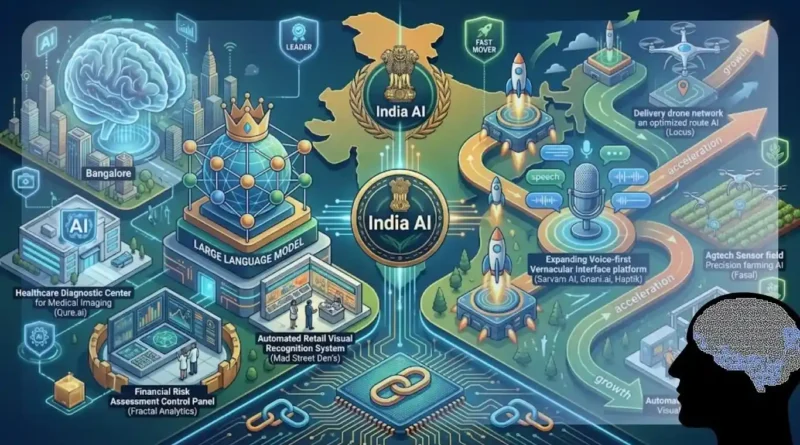
Top AI Startups in India 2026 – Leaders & Fast Movers
India is rapidly evolving into an international powerhouse in artificial intelligence. With an abundance of skilled tech professionals, strong support from the government, and a culture that is characterized by deep technological advancement, the world of AI companies in India has never been as promising. With 2026 just around the corner, the companies are moving beyond simple automation and chatbots. They’re developing complicated, domain-specific models that are making enterprise software revolutionary, as well as solving unique issues across a variety of sectors.
If you’re looking to know what direction technology is headed, then you have to examine the team of founders and developers who have created this revolutionary platform right now. There is a rapid increase in the fields of health diagnosis, forecasting financials, and massive-scale processing of language. We’ll take a deeper dive into the broader ecosystem and look at which companies will shape the future.
Why AI Startups in India Are Thriving Right Now
This current acceleration is not the result of chance. A number of converging elements create 2026 as a breakthrough year for companies that use artificial intelligence throughout the continent. The first is that the capacity of computing in India has grown significantly. Startups do not rely solely on infrastructure from abroad to build sophisticated basic models. Private investment has also moved from online commerce to deep technology, which provides the required infrastructure for high-risk research AI initiatives.
Additionally, the sheer volume of data in the United States is an enormous benefit. The companies can develop their algorithms with a wide range of diverse and multilingual datasets that are hard to replicate in other places. The unique setting allows programmers to design highly robust and adaptive algorithms that work superbly in international market.
Top AI Startups in India Pushing the Boundaries
The market is huge; however, a handful of specific areas stand out due to their speedy growth and remarkable market adoption. Let’s take a closer analysis of the major industries and firms that lead the charge.
Leading AI Startups in India Transforming Healthcare
Healthcare is among the areas that are most crucial for AI-based applications. Many forward-looking AI businesses from India focus on the development of predictive diagnostics, personalized medicine and medical imaging analysis. They use sophisticated computer vision technology to identify abnormalities in X-rays as well as MRI scans, with precision levels that are often higher than human norms.
Through the integration of their products directly into workflows in hospitals, they help physicians prioritize critical cases more quickly. They not only save lives, but they also significantly minimize the operational stress of medical facilities that are understaffed. The emphasis has moved from just providing software, to the delivery of quantifiable clinical outcomes.
Innovators in Multilingual Generative AI
Diversity in languages presents a unique problem and an opportunity. With more than a dozen official languages and a myriad of dialects to choose from, creating an diverse AI needs sophisticated modeling of linguistics. A new generation of AI companies that are generative AI firms has emerged to address this issue. They’re building massive model of language specifically based using local data.
The models that underpin them power everything from rural customer support bots, to voice-activated agriculture advisories to help farmers. Through democratizing information access in the native language These startups are helping to bridge the digital divide while gaining huge economic value throughout the entire country.
Disruptors in FinTech and Fraud Detection
The sector of finance produces huge quantities of transactional data each second. Startups are developing automated fraud detection systems using deep learning techniques to detect anomalies prior to transactions close. They analyze a variety of different variables, such as customer behavior, context of location as well as historical patterns of spending.
Beyond the fraud issue, the areas of wealth management an, credit scoring are also seeing an increase in AI integration. Businesses are helping millions of individuals who have never had access to banks obtain microloans by studying alternative information points. This is creating a more welcoming financial market while also managing the risk for lenders.
Key Geographic Hubs Driving the Innovation
There is a lot of talent throughout the nation; a few cities have established themselves as the most important innovation hubs. There is no doubt that the AI startups in bangalore benefit significantly from the established technology infrastructure as well as its deeply-rooted engineering tradition. A high percentage of venture capitalists and research institutes in the city provides a great setting for rapid prototyping and growth.
Other cities, such as Hyderabad and Pune,e are rapidly getting ahead. The state government is establishing specific AI parks and providing substantial support for companies that are in the deep tech sector. The decentralization of talent can help businesses manage their operational expenses while also allowing them to grow their engineering teams rapidly.
Cloud Infrastructure and the AI Backbone
Scaling and building AI models demands a lot of computing power as well as a sophisticated backend infrastructure. The next-generation language cannot be run on models on older servers. This requirement has led to another market for businesses focused on optimization and implementation.
The backend experts assist AI firmin managingge server workloads continuously. In particular, efficient inter-cloud resource management allows the heavy compute startups to move the workloads effortlessly between various cloud providers in real-time, based on prices and availability. It also ensures that their AI models will be accessible without burning through the capital of venture investors just to ensure that the servers are running.
The Role of Government and Policy in 2026
The regulatory frameworks are finally become more in line with the technological revolution. The government has issued explicit guidelines on the privacy of data, transparency in models, and the ethical aspects of AI deployment. In contrast to limiting innovation, these clear rules of the road have actually helped accelerate enterprise adoption.
Large companies are now confident that they are able to integrate AI applications from local startup companies that are compliant with the national standards for data protection. Furthermore, grants from the government specifically targeted at AI study in agriculture as well as defense offer non-dilutive funds, which help founders in the early stages of their development to develop their ideas and bring them to reality.
Challenges Facing the Next Generation of Founders
Despite this huge potential of the business, entrepreneurs still have many obstacles. Finding high-quality, impartial training data is costly and takes a lot of time. Also, there is a continuous competition for the best talent. Although the nation is home to millions of engineering experts, the developers who have deep knowledge in neural network design and optimization of machine learning are in huge demand.
As models get more complicated, the expense of their training increases. Startups have to balance the necessity to create cutting-edge technology alongside the necessity of achieving the point of profitability. In 2026, investors are searching for ways to generate revenue clearly, which means founders have to prove that their business is viable sooner than they were five years ago.
Conclusion
The world of technology is evolving rapidly. The most effective AI startups in india are focused on removing the hype surrounding artificial intelligence to focus on real-world, tangible challenges. They are either developing better medical diagnostics and improving financial services to be more inclusive or creating huge multilingual models of language. These companies are proof that innovation from India can be competitive on a global level. When computing power becomes more available and the pool of talent expands, we can anticipate further radical advances in the near future. Pay attention to these innovators andspeedy-movingg companies, who are busy creating the next chapter in technological advancements across the globe.
FAQ
Q1: What is it that makes India’s Indian AI startup scene distinct?
A1 The ecosystem is thriving due to the huge diversity of data as well as a large engineering talent pool, as well as the requirement to tackle complicated problems on a large scale. Businesses here typically develop solutions that are extremely affordable and flexible, making their products extremely competitive on global market for technology.
Q2: What sectors have seen the greatest AI technology innovation in India?
A2: Diagnostics for healthcare finance technology, healthcare diagnostics, as well as multilingual AI have seen the most rapid development. The startups in these areas receive the greatest funds because they tackle urgent, large-scale issues like accessibility to healthcare in rural areas and financial inclusion.
Q3 What is the way AI firms coping with the expense that comes from computing?
A3: A lot of companies are able to enhance their backend infrastructure, and do so with a high degree of efficiency. They employ clever deployment strategies, leverage computers that are not centralized and collaborate with local cloud providers in order to maintain their model-training and inference expenses at a minimum without losing efficiency.
Q4: Will it be difficult for these businesses to obtain the funding they need by 2026?
A4: Though seed capital is readily available, venture capitalists tend to be more cautious in the development stages. They require clearly defined revenue models as well as evidence of business adoption prior to writing big cheques, thereby avoiding the sole purpose of funding research, without commercial applications.

